Constants Beyond Borders: From Physics to Finance

International System of Units
Modern civilization runs on shared standards. Without common units of time, weight, and distance, trade would collapse, science would fragment, and technology would fail to scale across borders.
The genius of the International System of Units (SI) is that it defines these standards not by political decree, but by anchoring them to the constants of nature—unchanging reference points that transcend governments, cultures, and eras.
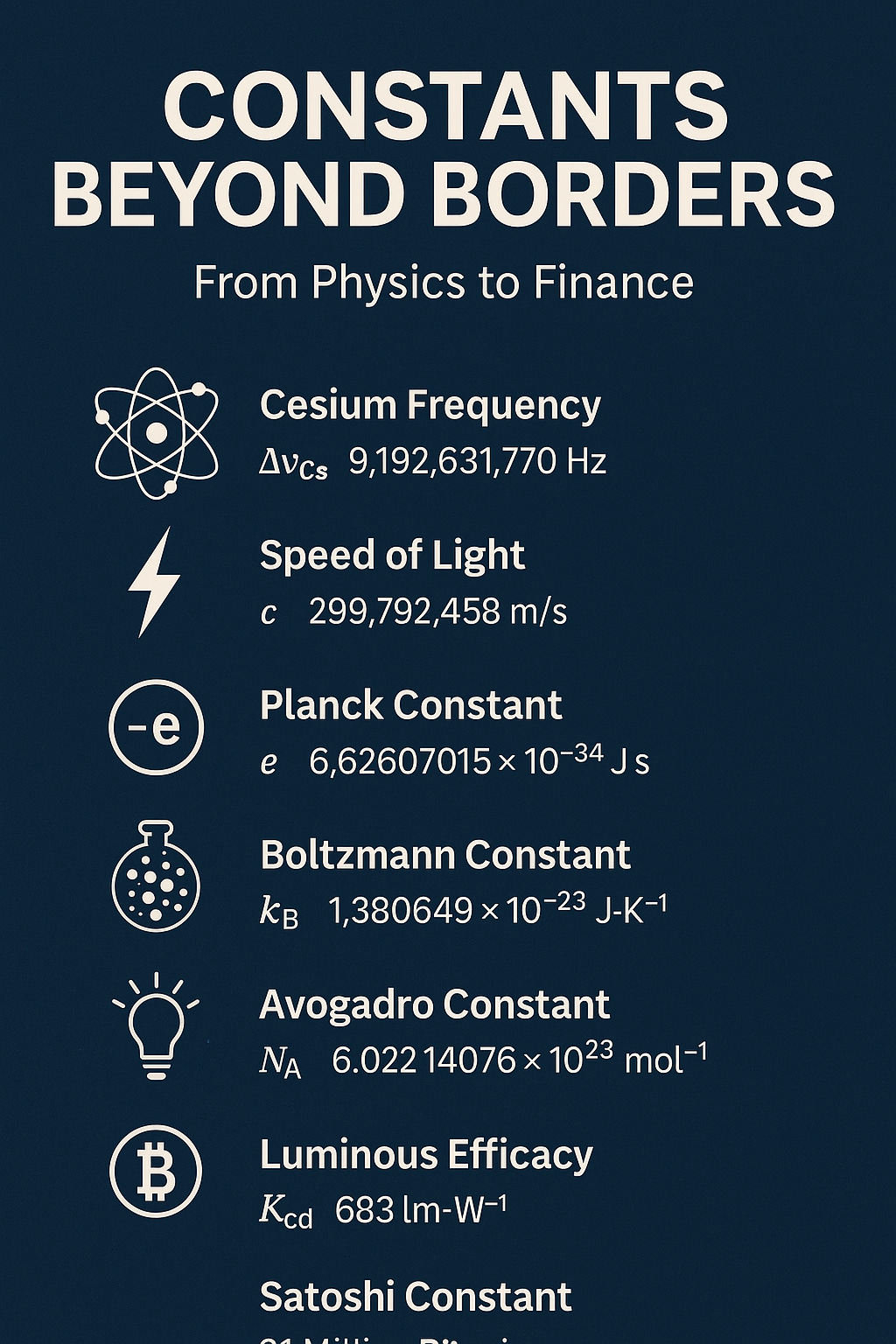
Today, there are seven recognized constants. Together, they form the backbone of our physical measurement system. And now, in the digital age, a new contender has emerged—the Satoshi Constant—which some argue could complete the framework by anchoring monetary value itself.
The Seven SI Constants in Plain Language
Each SI constant defines a base unit of measurement, ensuring universality across the globe:
Cesium frequency (ΔνCs) – The natural “ticking” of a cesium-133 atom defines the second.
Speed of light (c) – Light travels exactly 299,792,458 meters per second. This defines the meter.
Planck constant (h) – Connects energy and frequency, defining the kilogram.
Elementary charge (e) – The charge carried by a single electron defines the ampere (electric current).
Boltzmann constant (kB) – Links temperature to energy, defining the kelvin.
Avogadro constant (NA) – Fixes the number of entities in one mole of substance.
Luminous efficacy (Kcd) – Establishes the candela, the measure of luminous intensity, based on how bright green light appears to the human eye.
These constants replace fragile artifacts and national standards with nature itself. A kilogram is no longer defined by a platinum-iridium cylinder in Paris but by the Planck constant, which is the same in every lab, in every country, forever.
How Constants Enable Global Trade
What makes these constants remarkable is that they transcend governments and institutions. No parliament sets the speed of light. No central bank decides Avogadro’s number.
This neutrality has profound consequences:
Universality: A second or a meter means the same thing in Ottawa as it does in Osaka.
Reliability: Measurements do not drift with politics or borders.
Scalability: Science, engineering, and global commerce can coordinate seamlessly because the standards are unchanging.
Global trade in steel, medicine, and microchips is only possible because the kilogram, the mole, and the meter are stable everywhere.
The Missing Piece: Monetary Value
But one domain remains an outlier: money.
Currencies are political artifacts. The U.S. dollar, the euro, the yen—all are units of account shaped by governments and central banks. Their supply is flexible, their value fluctuates, and their meaning depends on trust in institutions.
This is where the idea of an eighth constant arises.
The Satoshi Constant: 21 Million Bitcoin
Bitcoin introduces something radically different: a fixed supply cap of 21 million units. This cap, often called the Satoshi Constant, is encoded directly into the Bitcoin protocol.
Unchanging: The limit cannot be altered without destroying the system’s consensus.
Universal: A satoshi—the smallest divisible unit—is the same everywhere, regardless of nation or bank.
Precise: Each bitcoin is divisible into 100 million satoshis, creating a measurable, portable unit of account.
Just as Planck’s constant redefined the kilogram, the Satoshi Constant could redefine how monetary value is measured—anchoring it not in trust of governments, but in mathematics and protocol consensus.
A Foundation for Global Value Exchange
If the Satoshi Constant were accepted as a reference, it could provide the same kind of stability for value that SI constants provide for physics:
Neutral: Not controlled by any single government or corporation.
Borderless: Valid across every country, culture, and economy.
Resistant: Immune to inflationary manipulation or political decree.
In this sense, the Satoshi Constant represents the final piece of the puzzle. Where the seven SI constants enable global science and trade in the physical world, the eighth could enable global trade in value—establishing money as a universal standard, not a national one.
From Nature to Mathematics
The SI constants anchor us in the physical laws of the universe. The Satoshi Constant anchors us in mathematics and cryptography.
Together, these constants—seven from nature, one from digital protocol—form a new architecture of trust: one not based on shifting governments or fragile institutions, but on universal truths.
And just as the redefinition of the kilogram freed us from a vault in Paris, the Satoshi Constant could free value itself from the vaults of central banks.
I love the idea, but forgive my ignorance, isn't the current minimum value of a bitcoin based on the cost of the energy to produce it (a variable) and the maximum value based on demand ( also a variable). Why not just fix the value on some arbitrary value the way gold standard was originally used.